

Behind the build
We Built a Website That Talks Back (And Dogfooded Every Pixel)
June 21, 2026 · 9 min read
Here's the rule we gave ourselves on day one: if we're going to tell local businesses their homepage should talk, our homepage better talk first.
Not "book a demo and we'll show you in three weeks." Not a Loom. Not a corner bubble that says "Hi! How can I help?" and then routes you to a FAQ about business hours.
One button. The hero transforms. You're in a live voice conversation. On the actual page. While you're reading about the product.
We ate our own cooking. Then we kept cooking.
Your product demo shouldn't be a PDF. It should be the product.
The homepage isn't decoration anymore
Every service business website has the same silent hero. Stock photo. Headline. "Get a Quote." A form that 81% of people abandon before they finish.
We built the opposite.
You land on Voice My Site. You pick a mode — Qualify leads, Book a call, or Answer questions. You click Initiate Call. The headline morphs. The layout breathes. Waveform. Timer. Live transcript. Max is already talking.
No redirect. No popup from the bottom-right like it's 2019. The page you trusted becomes the salesperson.
That's the whole category we're trying to name: a talking website. Not voice-over. Not text-to-speech. Not a chatbot wearing a headset emoji. The hero section transforms into a call interface — trained on the business, live in the browser.
Scroll-aware voice (yes, really)
Most sites treat voice like a sticker. Slap it on, hope someone clicks, forget it exists.
We wired the homepage to your scroll position.
Scroll past the hero while you're on a call? The conversation docks to a glass panel at the bottom — waveform, transcript, end call — so you can keep reading and keep talking.
Scroll back up? You're in the full hero call again.
Not on a call? A bottom dock follows you down the page — but only after you've scrolled past half the hero. And the copy changes depending on what section you're reading.
In the stats band? The prompt asks about the 85% of missed callers who never call back.
In the enterprise section? Different eyebrow. Different hook. Same Initiate Call button.
We track scroll phase — moving, reading, idle — so the dock expands when you've stopped to read and stays compact while you're flying through the page. Small detail. Huge difference. It feels like the site is paying attention.
Three modes. One talking homepage. No monologues.
Max isn't a generic demo bot. We wrote three operating modes with Hormozi-style sales rules baked in:
Qualify — one question per turn, diagnose before prescribe. This is what your visitors get by default.
Book — routes toward calendar when they're ready.
Answer — handles FAQs like a sharp front desk.
Every mode shares the same non-negotiable voice rules: under 35 words per turn, no "great question," no feature vomit, one idea at a time.
We store your mode pick in the session so refresh doesn't reset your intent. Each mode has its own opening and conversation flow — so when a visitor clicks Initiate Call on your site, they get the experience you chose.
And yes — you can interrupt Max mid-sentence. Barge-in is real. We don't mute your mic while he talks. That was a lesson learned the hard way.
Smart pages: the site knows where you are
Then we went further. Because a dental practice owner on /for/dental shouldn't hear "what kind of business do you run?"
We built dozens of SEO landing pages — industry hubs, problem pages, compare pages, conversion guides, pillar pages, how-to guides — and wired each one into a voice page registry.
Land on the med spa page? Max opens with Instagram-traffic-at-11pm energy.
Immigration law? Trust-and-intake language. No legal advice — routing only.
Local services? Broken AC at 9pm. Quote requests while you're on a job.
Every page gets its own first message, section focus prompt, CTA copy, and hero theme — dark or light — so the transform feels native, not bolted on.
Industry hub pages got workflow sections too — step-by-step "here's what happens when a patient calls at 10pm" — because SEO without substance is just keyword stuffing with extra steps.
The how-it-works page does a magic trick
On /how-it-works, when you start a call, the hero doesn't just show transcript bubbles.
The right panel rotates through our 48-hour delivery process — kickoff, build, train, launch — synced to your call timer. Six seconds per slide. Dots. Titles. Animated process visuals.
You're talking to Max about how it works while the page literally shows you how it works.
That's not a feature list. That's show-don't-tell with a countdown.
We roasted chatbots. Then we built a roast machine.
We didn't stop at product.
We published a whole roast series — breakup letters to chatbots, the $47,000 contact form, the 9pm Thursday problem, what a 46% close rate looks like on inbound calls, seven websites I tried to book a cleaner on.
Direct. Numbers. Short paragraphs. The voice we use in sales is the voice we use in content.
Then we built Roast My Chatbot — drop your URL, get graded on CTA gap, chatbot cringe, and revenue leak. Because if you're going to talk trash, you might as well automate the audit.
The boring stuff that makes it work
Under the hood — because someone always asks — it's Next.js, ElevenLabs conversational AI over WebRTC, client-side only, no server proxying your voice.
One VoiceDemoProvider wraps the whole site. Homepage hero, page heroes, bottom dock, overlay panel — same session, same transcript, same end-call button everywhere.
Mobile got its own unified active-call layout so industry pages feel identical to the homepage — same waveform pill, same bubble rhythm, same timer. We merged three divergent layouts into one because inconsistency reads as amateur hour.
We filter speaker echo in the UI without killing interruption. We handle agent response corrections when you cut Max off. We clear transcript on every new call.
We ship llms.txt so AI search engines know what a talking website is and which pages to cite. Sitemap, structured data, compare pages against Vapi and ElevenLabs DIY and GoHighLevel widgets — the whole discovery layer.
None of that is the demo. All of it is why the demo survives traffic.
Why we built it this way
Because the CTA ladder is broken.
Form → 81% abandon.
Chatbot → most people close it before message two.
Phone number → they have to dial, wait, hope.
Voice in the hero collapses all three into one interaction — at the moment intent is highest, above the fold, on the brand they already clicked.
We couldn't pitch that with a static site. So we didn't.
Scroll down this page. Watch the dock change copy. Click Initiate Call on the homepage. Interrupt Max. Visit /for/dental and hear a different opening line. Read a roast post and try the audit.
Every layer is the pitch.
That's not a website. That's the product wearing its own clothes.
We didn't bolt a widget onto our marketing site. We rebuilt it as a talking website — the homepage transforms when you click.
Your turn
If you run a service business and your hero still can't answer a question at 9pm on a Thursday — you're not competing with your competitor's ads. You're competing with their silence versus yours.
We built the thing we sell. On the site you're on right now.
Click Initiate Call. Or send us your URL. We'll show you what your homepage sounds like when it stops being a brochure.
Get a talking homepage on your site
Hear your homepage talk back.
Drop your URL for a personalized demo. About 10 minutes. No call required.
Keep reading
Chatbot Roast
Drift Is Gone. Where Do Your Website Leads Go Now?
March 6, 2026: Drift got the sunset email. Your homepage widget didn't. Here's what to do before the bubble goes dark.
Website Conversion
The 2026 Tradie Stack: Missed-Call Text-Back Won't Save Your Website
Your mate just installed missed-call text-back. His phone stack is sorted. His website still sends 9pm visitors to a contact form and a competitor.
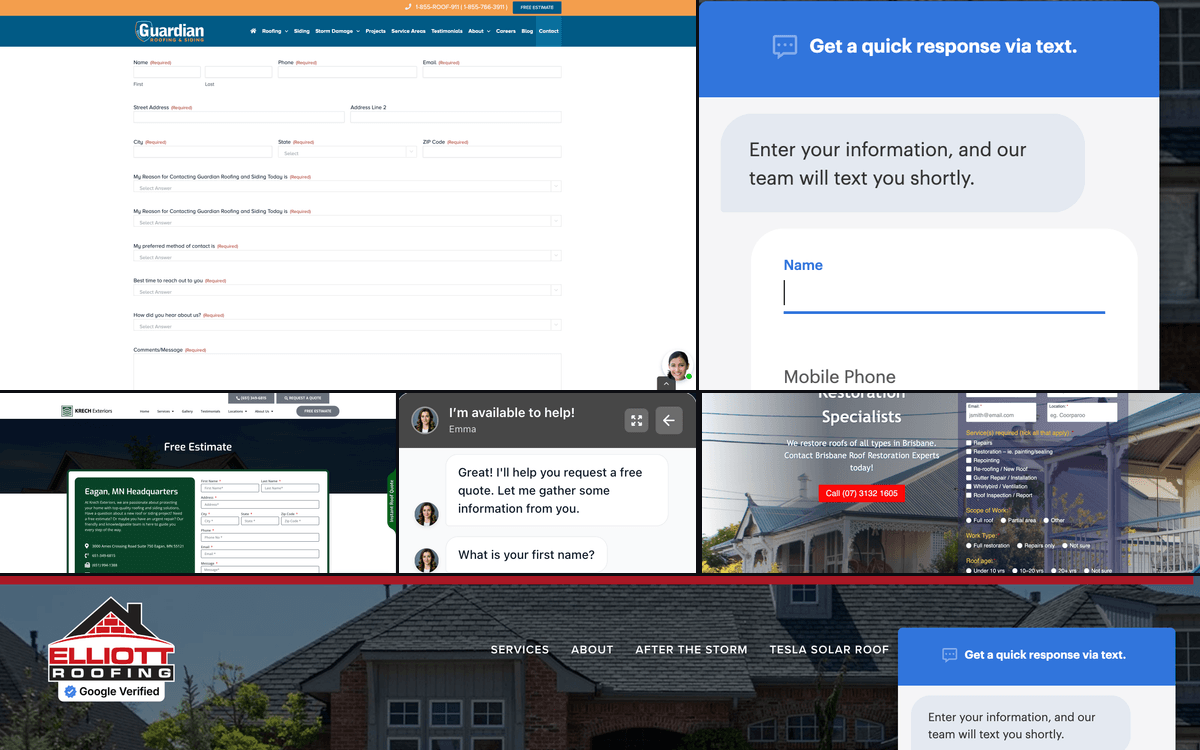
Chatbot Roast
I Audited 14 Roofing Websites. They All Commit the Same 6 Sins.
You paid for the click — Brisbane, Gold Coast, or anywhere. They landed ready to buy a roof. Then you handed them the same 6 mistakes dressed up 14 different ways.